A galaxy, not a single stretch of stars
The Milky Way is the galaxy that contains the Sun, Earth and every other object in the Solar System. A galaxy is a collection of stars, gas, dust and other material held together by gravity. The Milky Way contains an enormous number of stars, many with planetary systems of their own. Its stars are separated by such great distances that even our nearest stellar neighbors lie far beyond the outer planets.
The Solar System is a much smaller arrangement: the Sun and the planets, moons, asteroids, comets and other objects bound to it. Earth orbits the Sun; the Sun, carrying the Solar System with it, travels around the Milky Way’s center. Keeping these two scales separate makes it easier to picture our place in space: a planet belongs to a planetary system, and that system belongs to a galaxy.
Why the Milky Way looks like a pale band
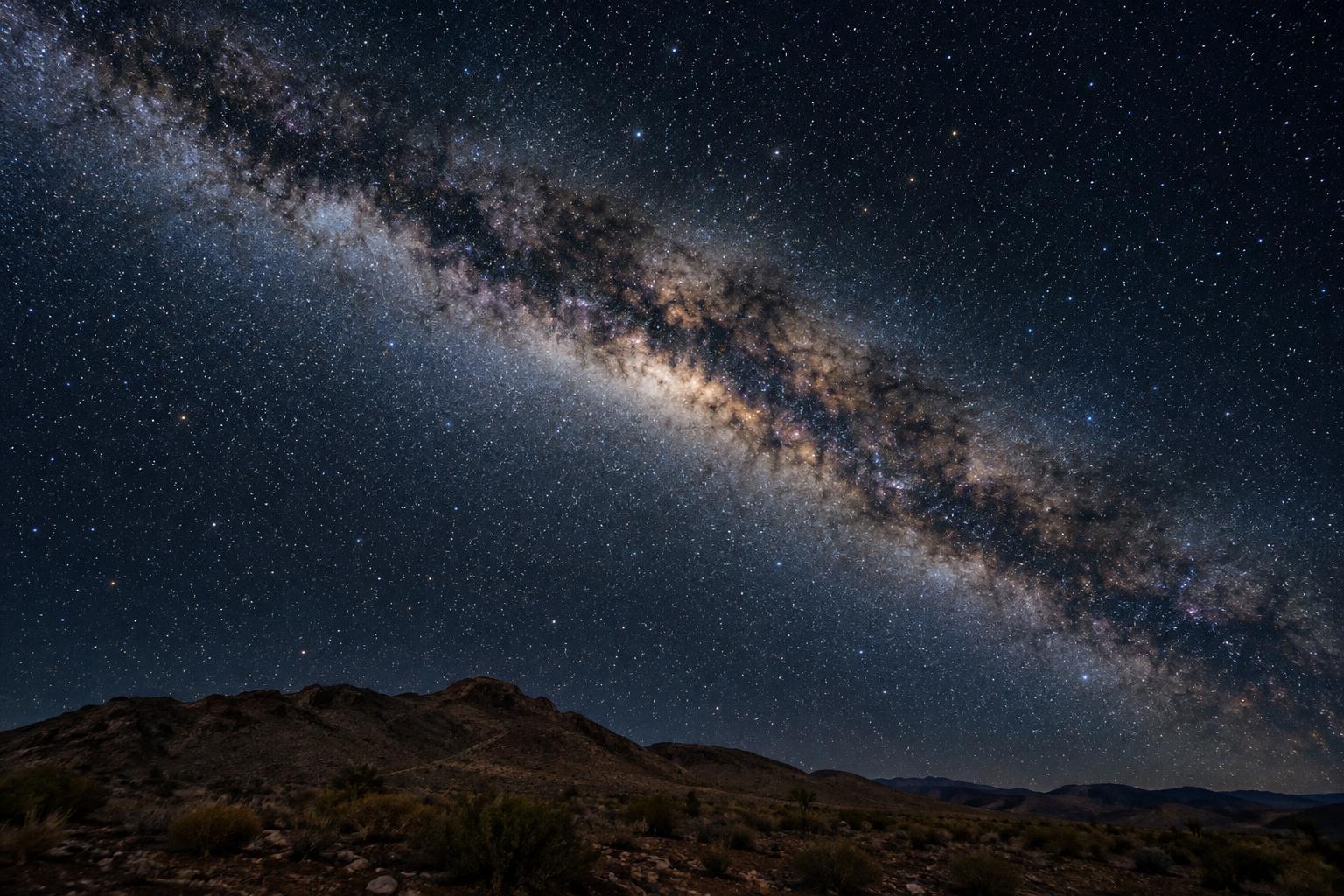
From a dark location, the Milky Way can appear as a hazy band across the night sky. That glow is not a cloud close to Earth. It is the combined light of many distant stars that are too faint or crowded together for our eyes to distinguish individually. Dark patches interrupt the band where interstellar dust blocks some of the light behind it.
We see a band because we live inside a broad, flattened disk of stars and gas. Looking along the disk, our line of sight passes through many more stars than it does when we look away from the disk. Imagine standing within a thin, wide crowd: it looks more crowded when you look across it than when you look up. The view changes with the season and with your location on Earth, but the underlying geometry stays the same.
The galaxy’s shape and its hidden parts
The Milky Way is generally described as a barred spiral galaxy. Its central region includes an elongated bar of stars, while its disk contains spiral patterns rich in gas, dust and stars. We cannot step outside the galaxy to photograph its full shape. Instead, astronomers map it from within by measuring the positions, motions and other properties of objects they can observe. Dust makes parts of the disk difficult to see in visible light, so the picture of its spiral structure is refined as measurements improve.
The bright disk is not the whole galaxy. A less densely populated halo extends around it and includes old star clusters. Evidence from the motions of stars and other objects also points to a much larger distribution of dark matter. Dark matter does not appear as a dark patch in a photograph; its presence is inferred from its gravitational effects. Near the galaxy’s center lies a supermassive black hole known as Sagittarius A*, but it does not hold the galaxy together by itself. Gravity from matter throughout the Milky Way shapes how its stars move.
Where the Sun sits
The Sun is in the Milky Way’s disk, well away from the center, in a smaller spiral feature often called the Orion Spur or Orion Arm. It lies between two more prominent spiral arms, commonly named Sagittarius and Perseus. Calling this region our galactic address is useful, as long as we remember that spiral features are not rigid tracks: stars move through the galaxy over time.
The Solar System travels around the galactic center along with other nearby stars. One circuit takes on the order of hundreds of millions of years, rather than the single year Earth needs to orbit the Sun. These motions happen at the same time. Earth’s familiar annual path does not replace the Sun’s journey through the galaxy; it is carried along within it.
Putting our home galaxy in perspective
The Milky Way is only one galaxy. It belongs to a group of galaxies that also includes Andromeda and numerous smaller neighbors. Beyond that group are many more galaxies. This nesting of scales—Earth, Solar System, Milky Way, wider universe—helps prevent a common mix-up: the Milky Way is not another name for all of space.
You can connect that vast scale to something observable. On a clear, dark night, the Milky Way’s band marks a view through the disk of our own galaxy. You are not seeing it from the outside; you are looking across it from a planet orbiting one of its stars. That ordinary-looking strip of light is a reminder that our night sky is a view from somewhere inside a much larger structure.