Properties begin with atoms, but do not end there
A copper wire, a glass tumbler and a rubber band behave differently even though all are made of atoms. To understand why, scientists look at how atoms interact and how they are arranged. A bond is a relatively stable attraction involving atoms and their electrons. Forming or breaking bonds involves energy, and moving atoms out of their preferred positions generally takes force.
Bonding helps explain properties such as strength, flexibility, melting behavior and electrical conductivity. But a bond type alone cannot predict everything about a material. The number and arrangement of neighboring atoms, the presence of defects, and the way a material was processed also matter. Think of bonding as part of the construction plan, not a complete description of the finished object.
Different bonds allow different kinds of movement
In many metals, electrons are shared across a large group of atoms rather than tied to one particular pair. This helps metals conduct electricity: charged particles can move through the structure. It also helps explain why many metals can be bent or drawn into wire. Layers of atoms can shift while the attraction holding the material together remains. Metals are not equally bendable, though; their composition and internal structure make a substantial difference.
Ionic solids form when positively and negatively charged ions attract one another in a repeating arrangement. Table salt is a familiar example. Its solid crystals can fracture when struck: a shift in the arrangement may bring ions with the same charge close together, causing them to repel. Solid salt does not conduct electricity well because its ions cannot move freely. When it melts or dissolves in water, mobile ions can carry charge.
Covalent bonds involve atoms sharing electrons. They can link atoms into small molecules, long chains or extended networks. That variety is important: saying a material has covalent bonds does not, by itself, tell you whether it will be soft, hard or flexible.
Arrangement can transform the same element
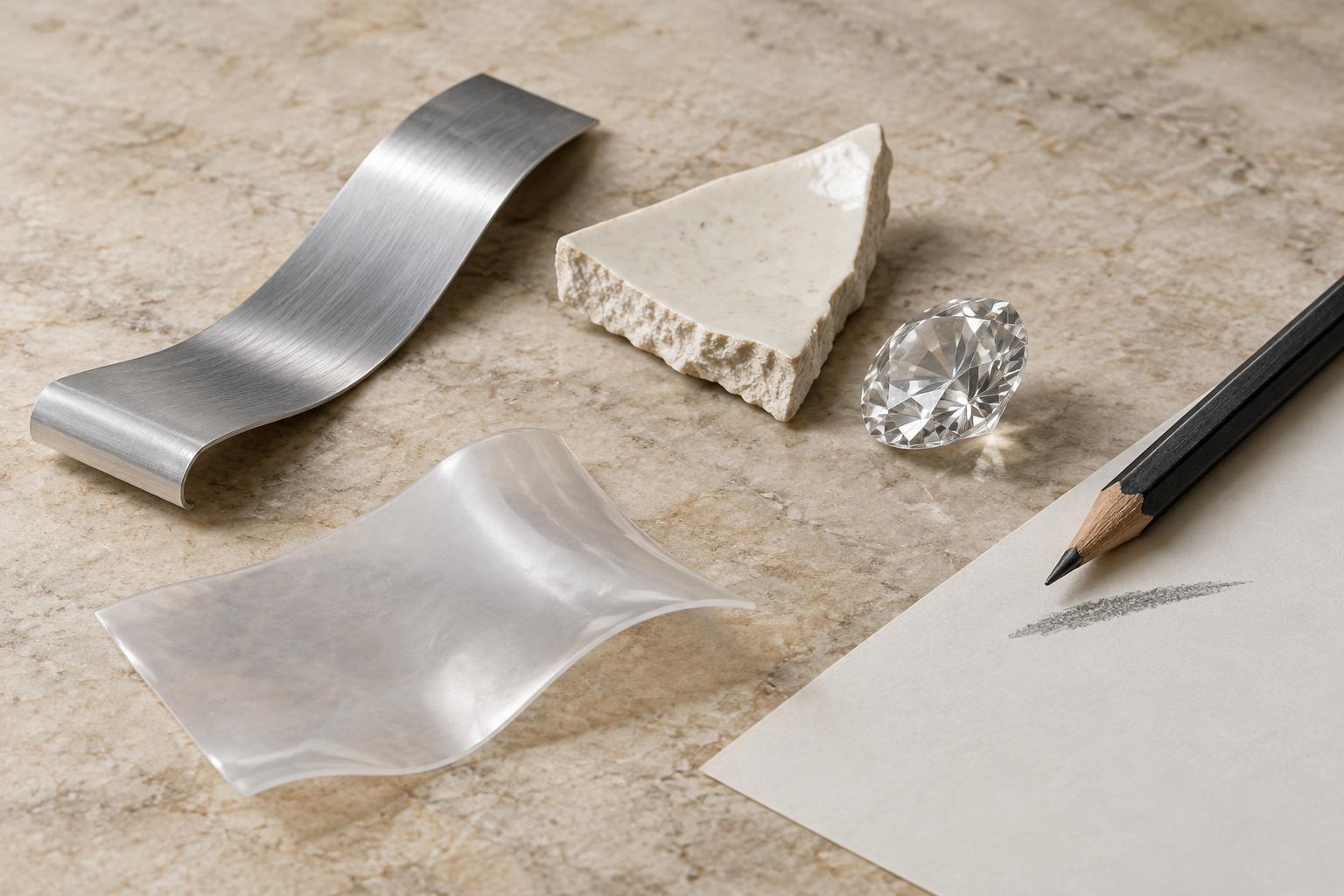
Diamond and graphite show why structure matters as much as ingredients. Both are forms of carbon. In diamond, each carbon atom bonds to others in a three-dimensional network. Scratching diamond requires disrupting this strongly connected structure, which helps account for its exceptional hardness. Hardness means resistance to scratching or indentation; it does not mean that an object cannot chip or break.
In graphite, carbon atoms form strongly bonded sheets. The sheets are held together much more weakly than the atoms within each sheet, so they can slide past one another. A pencil leaves a mark when tiny pieces of graphite transfer to paper. Graphite can also conduct electricity along its sheets, unlike diamond under ordinary conditions. The contrast comes from how carbon atoms are connected and how electrons behave in each arrangement, not from a difference in the element itself.
Molecules and chains add another layer
Water illustrates the distinction between bonds within a molecule and attractions between molecules. Strong covalent bonds hold each water molecule together. Weaker attractions between separate water molecules influence how water flows, forms droplets and changes between liquid and solid. A material can therefore have strong bonds inside its molecules without behaving like one rigid, strongly bonded network.
Polymers add further possibilities. Their molecules are long chains of repeating units, often joined along each chain by covalent bonds. The chains can be arranged loosely, aligned, tangled or connected to one another at additional points. Those differences help explain why one polymer can stretch and recover while another is stiff. Temperature can also change how easily chains move past each other. The result depends on both the bonds within the chains and the interactions and connections between them.
From a useful clue to a useful material
Bonding gives a starting point for choosing a material. A designer looking for electrical wiring might consider metals because many conduct well and can be shaped. A scratch-resistant surface calls for a different set of properties. Neither choice can be made from bond labels alone: a material also needs to suit its expected temperature, stresses and surroundings.
At a smaller scale, even two pieces with the same chemical composition can behave differently. Heating and cooling, stretching, or mixing in other elements can change the arrangement of grains, chains or defects. These changes affect how cracks spread and how atoms move. When you notice that a spoon bends, a cup breaks or a pencil writes, you are seeing the combined effects of bonding and structure at work.


