The tempting distance explanation
It seems reasonable to think summer happens when Earth is closer to the Sun and winter happens when it is farther away. But that idea runs into a problem: the Northern and Southern Hemispheres have opposite seasons. When people in the north experience summer, people in the south experience winter. Both hemispheres are essentially the same distance from the Sun at any given moment.
Earth’s orbit is slightly elliptical, so its distance from the Sun does change during the year. In fact, Earth is closest to the Sun during Northern Hemisphere winter and farthest away during Northern Hemisphere summer. Distance affects how much solar energy reaches Earth, but its yearly variation does not account for the familiar pattern of seasons. To understand that pattern, we need to look at how Earth is tilted.
A tilted planet moving around the Sun
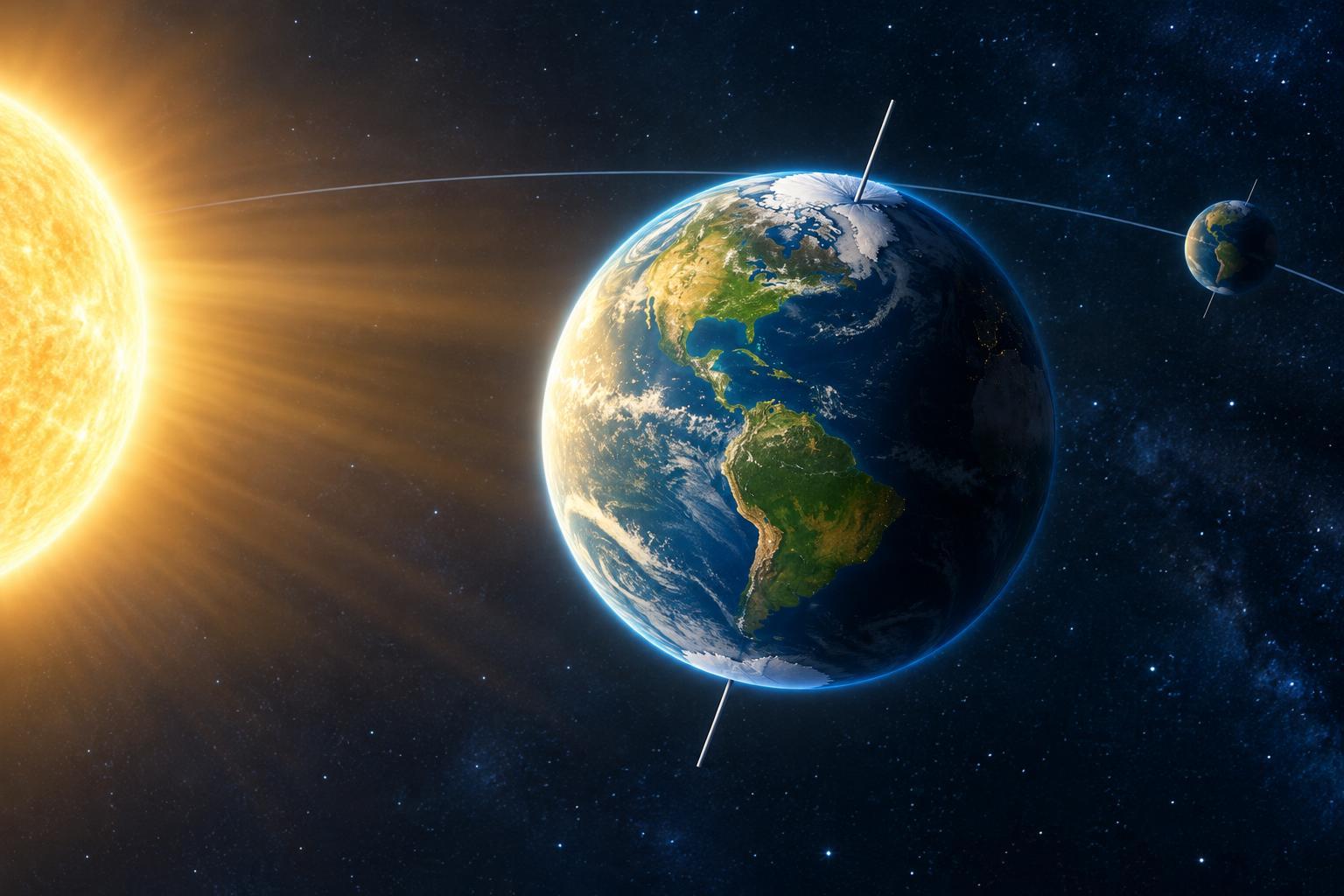
Earth spins around an imaginary line called its axis, which runs through the North and South Poles. That axis is tilted by about 23.4 degrees relative to a line perpendicular to Earth’s orbital plane. As Earth travels around the Sun, the axis keeps pointing in nearly the same direction in space. Consequently, each hemisphere takes a turn leaning toward the Sun and then away from it.
When the Northern Hemisphere leans toward the Sun, sunlight reaches northern locations more directly and the Sun stays above the horizon for longer each day. These conditions bring northern summer. At the same time, the Southern Hemisphere leans away from the Sun and experiences shorter days and less direct sunlight: southern winter. Half an orbit later, the arrangement is reversed.
Why sunlight angle and day length matter
Imagine shining a flashlight straight onto a tabletop, then tilting the beam so it strikes at a slant. The slanted beam spreads its light over a larger area. Sunlight works in a similar way. When the Sun appears higher in the sky, a given amount of incoming energy is concentrated on a smaller patch of ground. When the Sun stays lower, that energy is spread more thinly. Low-angle sunlight also passes through more atmosphere on its way to the surface.
The tilt changes more than the Sun’s height. It changes the time available for heating. Longer summer days allow the ground and oceans to receive sunlight for more hours; shorter winter days provide fewer hours of incoming energy. Seasons arise from these combined changes in sunlight angle and daylight duration, not from a hemisphere moving meaningfully closer to the Sun.
Solstices, equinoxes and the view from different latitudes
Around the June solstice, the Northern Hemisphere is tilted most directly toward the Sun and has its longest day of the year. Around the December solstice, it has its shortest day. The Southern Hemisphere experiences the reverse. Near the two equinoxes, neither hemisphere is tilted toward the Sun, and day and night are roughly equal in length across much of the planet.
The effect of tilt depends strongly on latitude. Near the equator, day length changes relatively little through the year. Farther from the equator, the difference between summer and winter daylight becomes more pronounced. Near the poles, the Sun can remain above or below the horizon for extended periods. This is why the same planetary tilt produces very different seasonal experiences in different places.
Why the warmest weather can arrive later
The longest day is not necessarily the hottest day. Land, water and air take time to warm after incoming sunlight increases, just as they take time to cool after it decreases. This delay helps explain why the warmest part of summer in many places comes after the summer solstice, and the coldest part of winter after the winter solstice. Local geography and weather influence the timing.
Distance from the Sun still has a modest effect on the sunlight Earth receives, and oceans and land can shape how seasons feel in each hemisphere. But the underlying explanation remains simple: as Earth orbits the Sun, its tilted axis changes both the angle and duration of daylight. That pattern gives the hemispheres their alternating seasons.