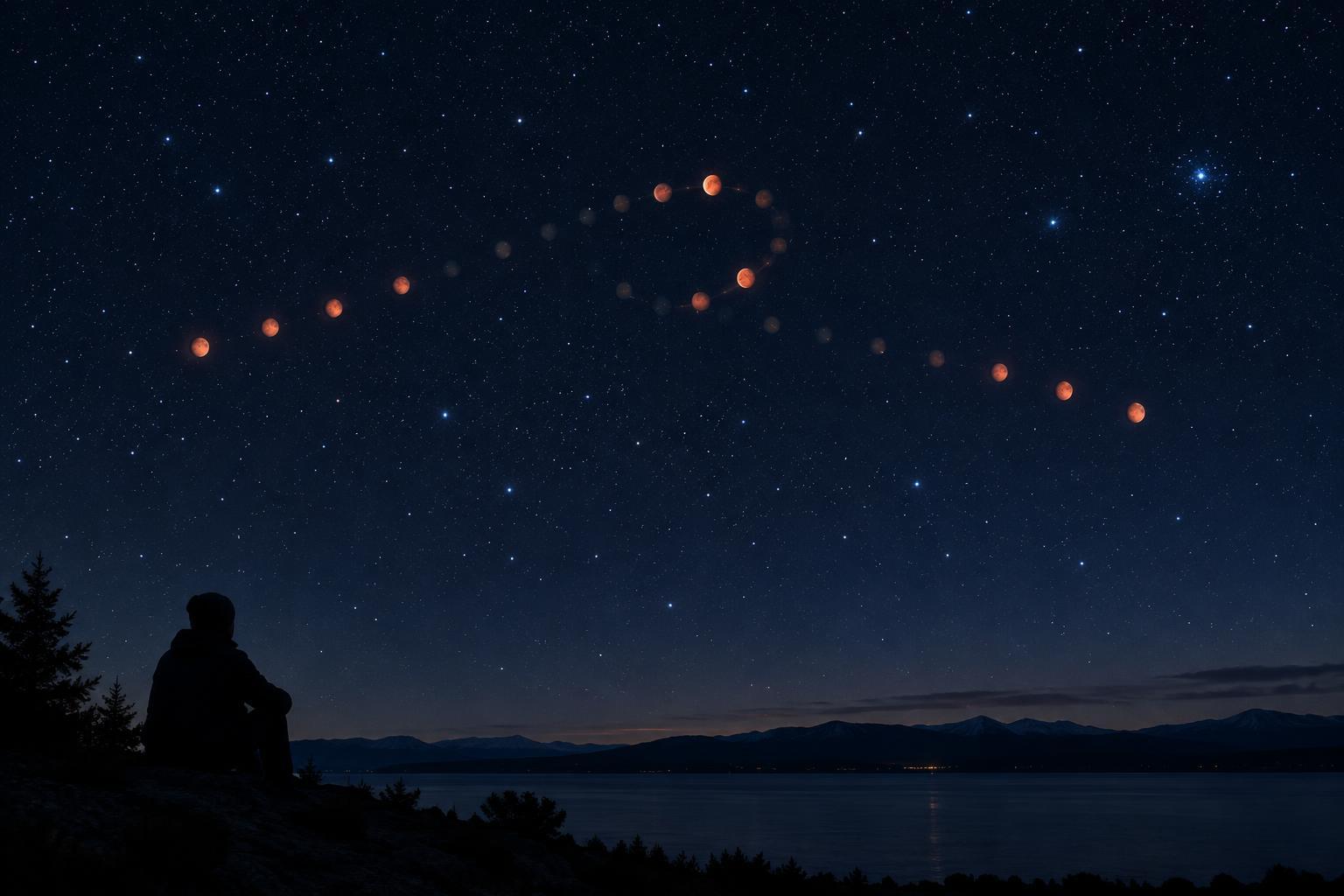
What does “backward” mean?
Watch a planet on several evenings, and it usually shifts gradually eastward against the background stars. At times, though, that shift slows, stops and briefly runs westward before returning to its usual direction. Astronomers call this apparent retrograde motion. The planet has not reversed its orbit around the Sun. What changes is the direction in which we see it from Earth.
This is separate from the nightly sweep of the whole sky. Earth’s rotation makes stars and planets appear to rise in the east and set in the west over a single night. Retrograde motion is much slower: it becomes noticeable when you compare a planet’s position with nearby stars over many nights or weeks. The stars provide a useful backdrop because their positions change very little on that timescale.
A moving observer changes the view
Imagine looking at a distant building from a moving train. A nearby sign can appear to slide across the building, even though neither object is traveling in the direction it seems to move. Its apparent position depends on where you are when you look. Something similar happens in the solar system: Earth and the other planets are all moving around the Sun, so the line from Earth to a planet keeps changing.
The effect is easiest to picture with a planet farther from the Sun than Earth, such as Mars. Earth follows a smaller orbit and moves around the Sun faster. As Earth catches up to and passes Mars, our viewing direction sweeps across the distant star background in a way that makes Mars appear to move westward for a while. Once Earth has passed, Mars resumes its usual eastward drift among the stars.
Why the reversal begins and ends
Mars does not abruptly switch direction in the sky. As Earth approaches the point where it passes Mars, the planet’s eastward motion against the stars slows. For a short time, it appears almost stationary. It then moves westward, slows again and returns to eastward motion. These pauses are often called stationary points, though Mars continues moving through space throughout the event.
For an outer planet, retrograde motion occurs around opposition, when Earth lies roughly between that planet and the Sun. At opposition, the planet appears on the opposite side of the sky from the Sun. The exact track against the stars depends on the planets’ positions and the tilt of their orbits. On a chart, the track may look like a loop or a gentle bend rather than a simple straight line traced backward.
Mercury and Venus have their own version
Mercury and Venus orbit closer to the Sun than Earth does. Because they move on the inside, their apparent retrograde motion is not a matter of Earth overtaking them in the same way it overtakes Mars. Instead, an inner planet’s changing position along its orbit alters our viewing angle as it passes between Earth and the Sun. Around that passage, called inferior conjunction, the planet can appear to shift westward against the stars.
Mercury and Venus stay relatively close to the Sun in our sky, which makes this motion harder to follow by casual observation. Near inferior conjunction, the Sun’s glare may hide them altogether. The geometry still produces an apparent reversal, even when the planet is not readily visible. Never try to locate a planet close to the Sun with binoculars or a telescope unless you have appropriate specialist guidance and equipment.
How to recognize the pattern
To understand retrograde motion, think in terms of positions on a map of the sky, not the direction a planet travels during one evening. A sequence of observations or charted positions against the same star pattern can reveal the slow eastward drift, the temporary reversal and the return to eastward motion. Looking at roughly the same time on different nights can also make the comparison easier.
The key lesson is about perspective. The planets continue orbiting the Sun in their usual directions while Earth moves too. Their apparent paths tell us about that shared motion and about the difference between where an object is and where it appears from our changing viewpoint. Retrograde motion is not an exception to planetary motion; it is a visible consequence of it.


