Sound is a traveling disturbance
Strike a glass gently and it vibrates. Its moving surface pushes on nearby air, creating a small region of higher pressure. As the surface moves back, it leaves a region of lower pressure. These alternating changes spread outward through the air. When they reach your ear, they make your eardrum vibrate, and your hearing system interprets the pattern as sound.
The air does not travel all the way from the glass to your ear. Instead, its molecules move back and forth around their usual positions, passing the disturbance along. Think of a line of people passing a gentle push from one person to the next: the push moves down the line, even though each person stays roughly in place. Sound is called a mechanical wave because it depends on motion in a material medium.
What a vacuum takes away
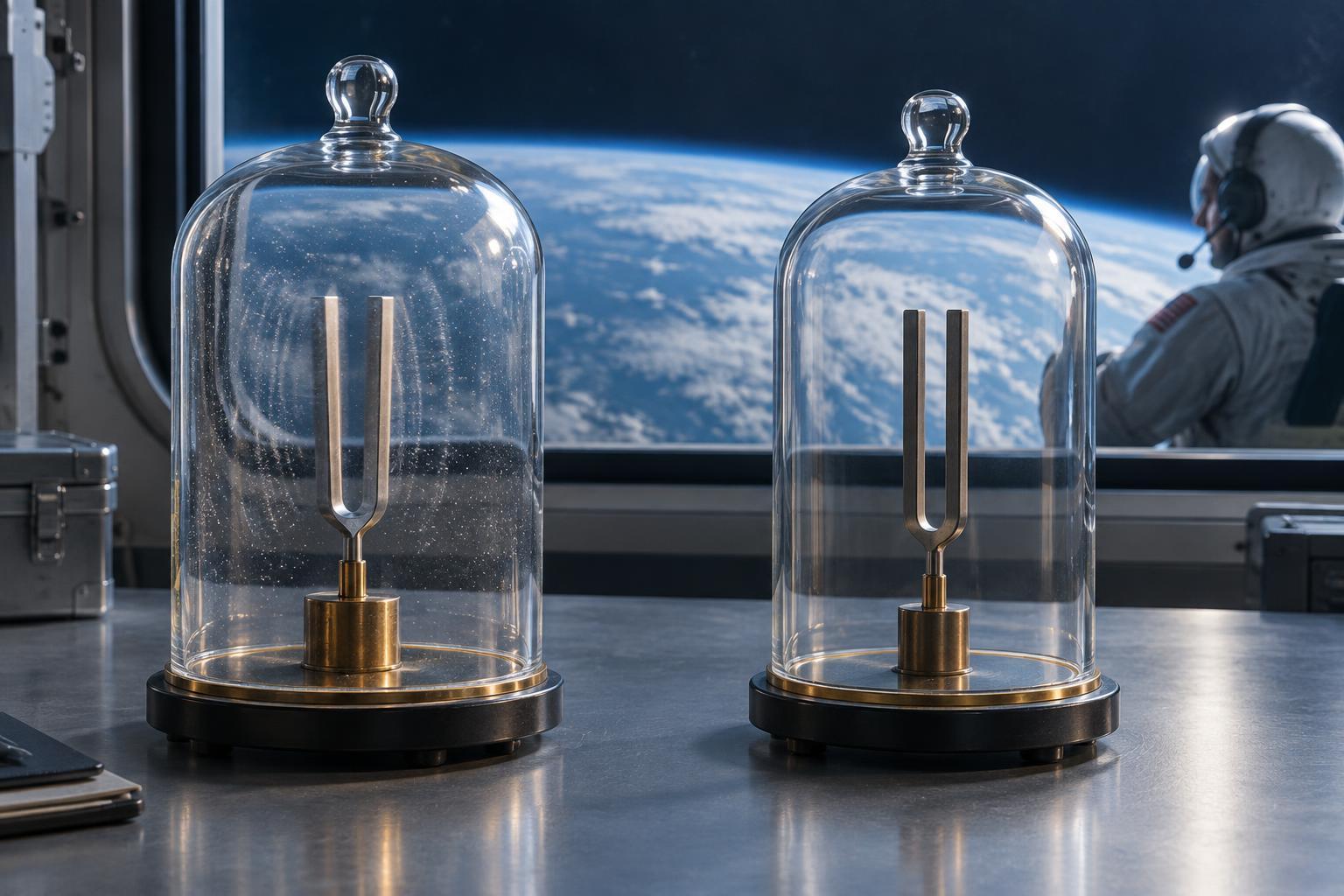
A vacuum is a region with little or no matter in it. With no particles available to pass along a pressure change, a sound wave cannot cross a perfect vacuum. A vibrating object placed there can still vibrate, but it cannot create an ordinary sound wave in the empty space around it. There is nothing there to compress and release.
Real laboratory vacuums are not perfectly empty, so it is more precise to say that sound becomes harder to transmit as air is removed. In a familiar bell-jar demonstration, a ringing device grows quieter while a pump removes air from the jar. Light from the device may remain visible because light, unlike sound, can travel through a vacuum. The demonstration needs care in its interpretation: vibrations can also pass through the device’s supports and the jar itself. It illustrates sound’s dependence on a medium rather than proving that every possible path for vibration has vanished.
Why sound travels through water and walls
Air is only one possible carrier. Water can transmit sound because a disturbance can make nearby portions of the water push on one another. Solids can transmit vibrations too. If you hear a knock through a closed door, some of the disturbance has traveled through the door and then set air on your side in motion.
How a sound behaves depends on the medium. Its speed, for example, is influenced by how readily the material resists compression and by its density. That is why there is no single speed of sound that applies everywhere. Sound can also change as it crosses from one material into another: some energy may pass through, some may reflect, and some may be absorbed. A wall can therefore carry vibrations while still making a voice on the other side difficult to understand.
Space is quiet, but not entirely empty
Movie explosions in space often come with a loud boom for the audience. An observer floating some distance away in a near-vacuum would not hear that boom directly. Even if the explosion produced a violent vibration, there would not be enough surrounding matter to carry ordinary sound from the event to the observer’s ears.
Outer space is not a perfect vacuum: it contains sparse gas and other particles. Waves can travel through some regions of that material, but the conditions differ greatly from the air around us. Calling space “silent” is a useful everyday shorthand, not a claim that vibrations are impossible anywhere beyond Earth. What matters is whether a suitable medium connects the source to a detector.
How astronauts communicate without sound crossing space
Astronauts can talk to one another because their voices first make sound waves inside their helmets or spacecraft, where there is air. A microphone converts those vibrations into electrical signals. A transmitter then sends information using radio waves, which are electromagnetic waves and do not require air between sender and receiver. At the other end, a speaker converts the received signal back into vibrations in the listener’s air-filled environment.
The distinction is between carrying sound and carrying information about sound. Radio can preserve a conversation across a vacuum, but the voice itself does not travel through that vacuum as a pressure wave. The same principle explains why you can see a distant event in space without hearing it directly: light can make the journey through empty space, while sound needs matter along its path.