A changing view of a sunlit world
The Moon can look like a thin curve one evening and a bright circle on another. Nothing is being added to or taken away from it. The Sun illuminates half of the Moon at any given time, just as it illuminates half of Earth. As the Moon travels around Earth, we see different portions of that sunlit half. Those changing views are the lunar phases.
An ordinary lunar phase is not Earth’s shadow moving across the Moon. If Earth blocked sunlight from reaching it, that would be a lunar eclipse, an occasional event rather than the cause of the familiar monthly cycle. To understand the phases, it helps to picture three objects: the Sun, which supplies the light; Earth, where you are standing; and the Moon, moving around Earth.
From new Moon to full Moon and back
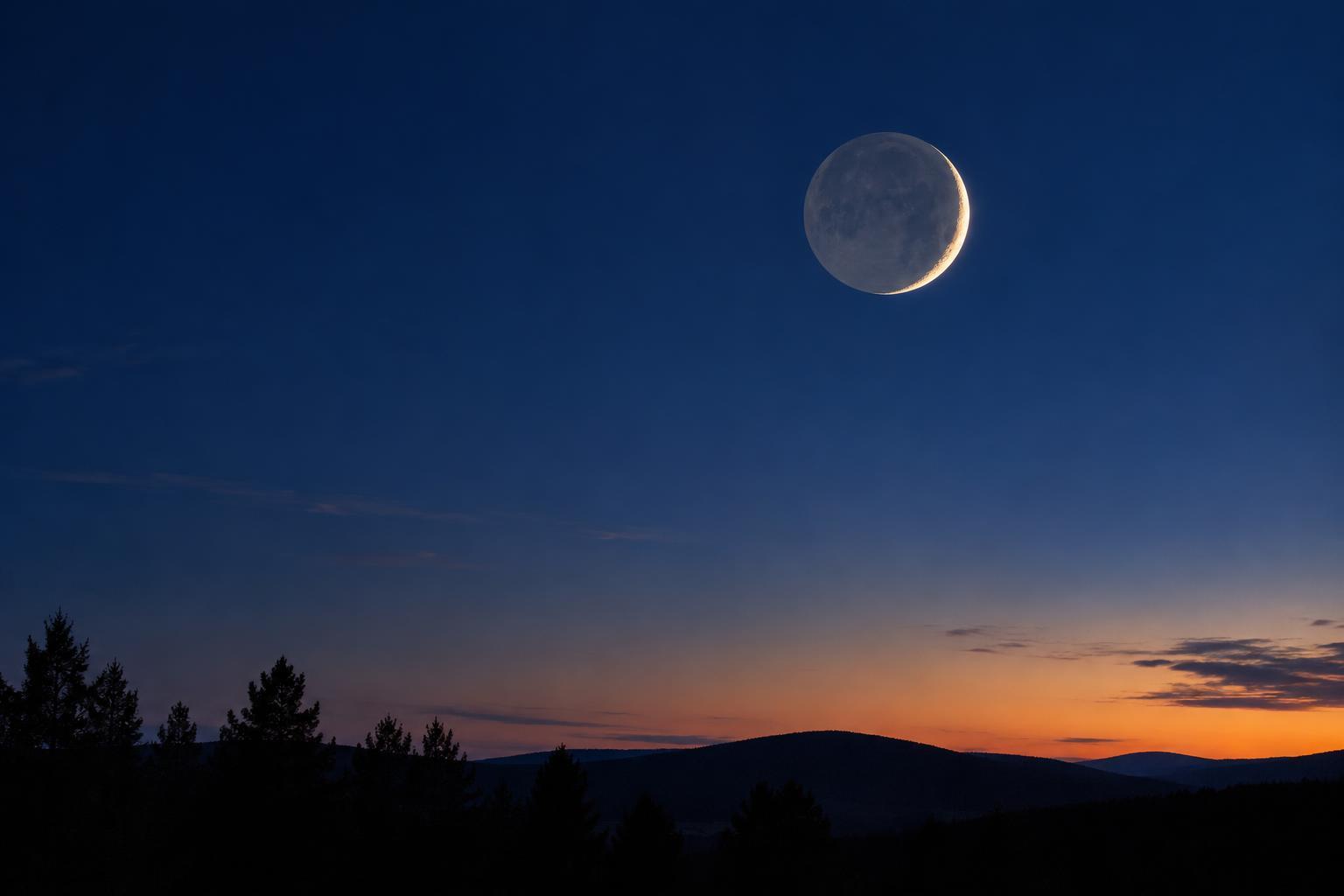
Near new Moon, the Moon lies roughly in the direction of the Sun as seen from Earth. Its sunlit half faces mostly away from us, while the side facing us is mostly dark. A day or two later, a slender crescent may become visible after sunset. Over the following nights, the lit portion we can see grows. This is called waxing. The Moon passes through first quarter, when it appears half lit, then becomes gibbous, meaning more than half lit but not yet full.
At full Moon, Earth lies roughly between the Sun and Moon. We see nearly all of the Moon’s sunlit half. Afterward, the visible bright portion shrinks, or wanes. The sequence runs through waning gibbous, last quarter and a final crescent before returning to new Moon. One complete cycle of phases takes about 29.5 days. The word “quarter” refers to a point about a quarter of the way through the cycle, not to the fraction of the Moon’s disk that looks bright.
Why phases affect when you see the Moon
The Moon’s position relative to the Sun also helps explain its place in our sky. A new Moon is near the Sun’s direction, so it is difficult to see in daylight and usually hidden by its own darkness. A waxing crescent tends to appear in the western sky after sunset. Around first quarter, the Moon is often visible in the afternoon and evening. A full Moon rises around sunset and remains visible for much of the night.
Later in the cycle, a waning Moon is easier to spot late at night or in the morning. These are useful patterns, not exact schedules: rise times vary with location and with the Moon’s changing path across the sky. They also show why “the night sky” tells only part of the story. The Moon can be visible during the day when it is far enough from the Sun in the sky and the viewing conditions are good.
Why there is not an eclipse every month
At new Moon, you might expect the Moon to pass directly in front of the Sun. At full Moon, you might expect it to move into Earth’s shadow. Usually neither happens because the Moon’s orbit is tilted relative to Earth’s path around the Sun. Most months, the Moon passes above or below the alignment needed for an eclipse.
An eclipse requires the phase and the alignment to coincide. A solar eclipse can happen only near new Moon, when the Moon is between Earth and the Sun. A lunar eclipse can happen only near full Moon, when Earth is between the Sun and Moon. The familiar progression of crescents, half Moons and gibbous Moons needs no such precise alignment; it follows simply from our changing viewing angle.
What to watch over the next few nights
Pick a clear view of the sky and note the Moon’s shape and position on several evenings. Is its bright portion growing or shrinking? If it is waxing, you will generally find it farther from the Sun’s direction than you did a few evenings earlier. You may also notice a faint glow across the dark part of a crescent Moon. Called earthshine, it is sunlight reflected from Earth onto the Moon and then back toward you.
The direction a crescent seems to face and the tilt of the boundary between light and dark can look different at different times and places on Earth. The underlying explanation stays the same: one half of the Moon receives sunlight, and its orbit changes how much of that half we can see. Following it for a few nights turns a familiar sight into a way to picture the Moon’s journey around Earth.


